


Traditional cooling tower design relies heavily on empirical rules and simplified formulas, making it difficult to accurately predict the complex fluid behaviors that occur during real-world operation. This often leads to discrepancies in energy consumption, water loss, and cooling performance. Linkcooling integrates advanced Computational Fluid Dynamics (CFD) simulation with authoritative CTI physical performance certification, enabling virtual validation and optimization of every detail during the design stage. This ensures that actual system performance approaches the “ideal value” rather than remaining only a theoretical estimate—delivering precise, efficient, and sustainable cooling solutions.
Dual Assurance from Virtual Simulation to Physical Validation
By combining CFD simulation software with CTI international performance certification, Linkcooling establishes a dual-layer reliability framework. This ensures that every cooling unit consistently delivers stable, above-standard cooling performance.
CFD Software Simulation (Virtual Validation)
Using advanced digital modeling technology, a 3D model of the cooling tower is created to simulate complex internal behaviors such as airflow, water flow, heat exchange, and drift behavior, identifying and resolving design blind spots in advance.
-
Create a 3D cooling tower model to simulate airflow, water flow, heat exchange, and drift phenomena.
-
Identify and correct potential design weaknesses early.
-
Convert simulation data into manufacturing standards to enhance product consistency.
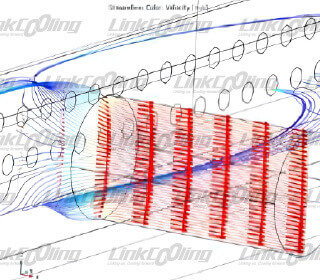
Pipe Pressure-Loss CFD Simulation
CTI Performance Certification (Physical Validation)
Finalized designs are submitted to laboratories certified by the Cooling Technology Institute (CTI) for rigorous testing. Key indicators such as cooling capacity, water loss, and power consumption must not only meet but often exceed international standards (with certified performance reaching up to 110%). This provides objective and authoritative validation of system performance.
-
Certified through stringent CTI laboratory testing.
-
Cooling efficiency, water consumption, and energy-use metrics fully verified.
-
Certified efficiency up to 110%, delivering validated high performance.
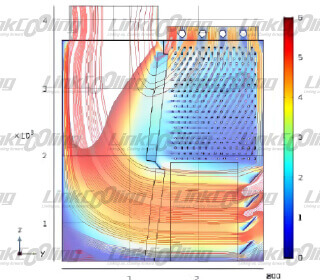
Cooling Field Simulation Analysis
Co-directional Air–Water Flow & Hybrid Flow System
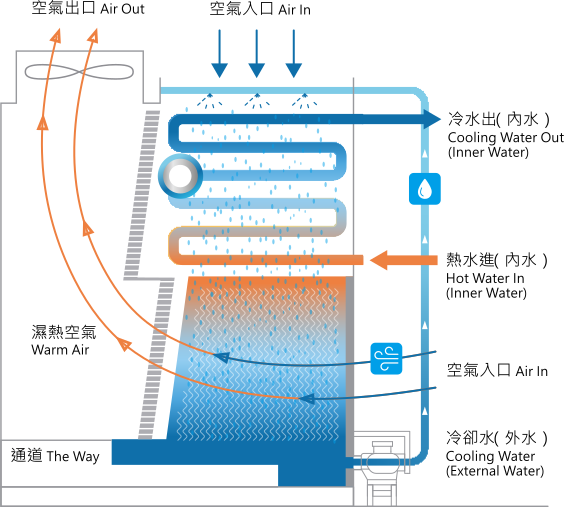
Through CFD simulation, Linkcooling applies co-directional airflow and water flow and a hybrid flow design to achieve physical performance breakthroughs:
-
Physical Separation of Fills and Coils:
Air (airflow) and water (spray water) operate independently, eliminating mutual interference and preventing airflow resistance from disrupting water distribution.
-
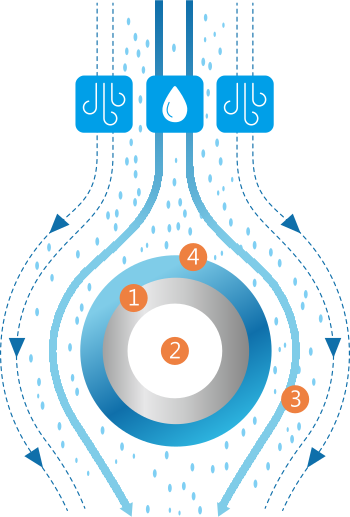
Co-directional Spray Water Adhering to Coils:
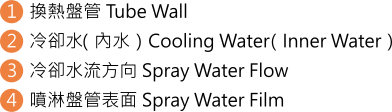
Guided airflow helps water evenly adhere to coil surfaces, reducing dry spots and lowering external coil scaling by 3–10%, while doubling the effective heat-exchange surface area.
-
Quick-detach Spray Pipes & Drift Control System:
Based on simulation optimization, quick-detach spray components and efficient drift eliminators reduce over 90% of drift losses, saving water and lowering maintenance costs.
Technical Applications
| Simulation Optimization Focus | Problems Resolved in Traditional Systems | Value & Benefits |
|---|---|---|
| Airflow & Flow-field Optimization | Uneven airflow distribution and short-circuit recirculation reduce heat-exchange efficiency. |
|
| Uniform Spray-water Distribution | Uneven spray causes coil dry spots, severe efficiency loss, and excessive scaling. |
|
| Internal Coil Flow Resistance & Pressure Drop Optimization | Poor pipe design leads to unbalanced flow distribution, weak terminal heat exchange, and excessive internal pressure loss. |
|
| Water-loss Control & Drift Prevention | Severe drift loss wastes water and affects the surrounding environment. |
|
Linkcooling’s CFD-Based Cooling Simulation Technology ensures stable and non-degrading cooling performance through combined CTI + CFD validation. Users benefit from longer equipment life, lower maintenance costs, and ESG-aligned reductions in energy and water usage—making it ideal for industries demanding extreme reliability and efficiency, maximizing the return on every unit of energy invested.