
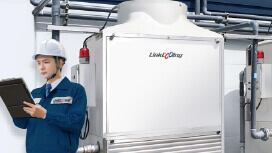
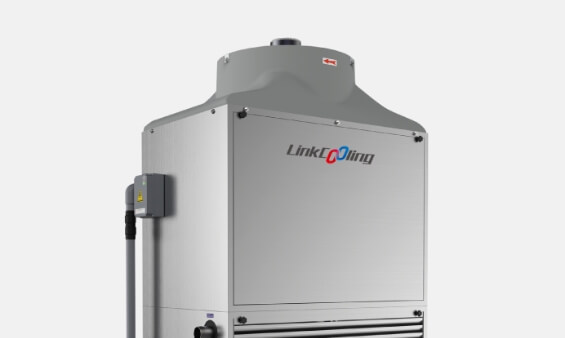
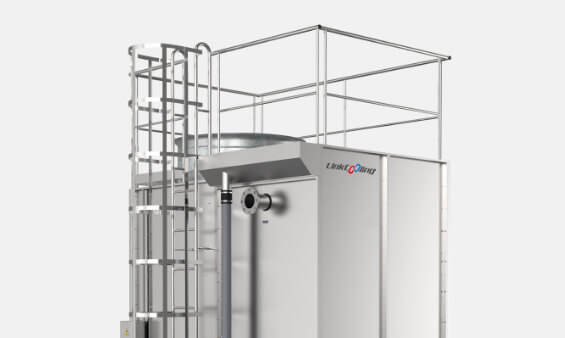
Built on Linkcooling’s fully closed dual-circulation architecture, combined with thermofluid design and a modular system framework, the Scale-free Closed Cooling System
fundamentally eliminates the traditional issues of scaling, corrosion, and biological growth caused by evaporative concentration and environmental contamination in conventional open cooling towers.
In open cooling systems, water quality continuously deteriorates during operation, causing heat exchange efficiency
to drop by 10–15% annually on average. The resulting chemical dosing, downtime losses, and manpower overhead
lead to significant recurring costs.
Linkcooling applies two core technologies — “complete isolation of internal and external water” and “extreme water quality management” — reducing scaling risk to near zero and lowering water treatment costs by 90%, while safeguarding long-term equipment performance and operational stability.
This design is especially suited for industries that demand exceptionally clean cooling water, such as semiconductors, precision manufacturing, plastics & rubber, and metal processing, delivering reliable, high-efficiency and low-maintenance thermal management solutions.
System Architecture
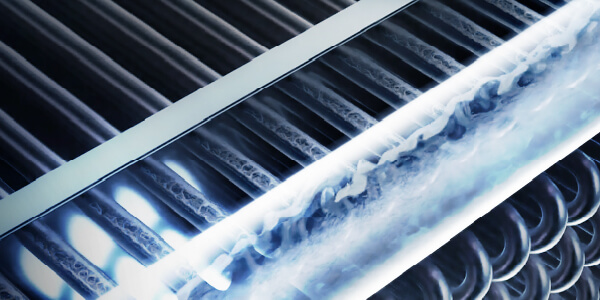
Primary Loop (Internal Coil Circuit)
The fully enclosed primary circuit circulates heated water inside the coil without evaporation or contamination, ensuring long-term purity and stability. With no concentration increase and zero scaling formation, the system maintains optimal heat transfer efficiency and significantly extends equipment life.
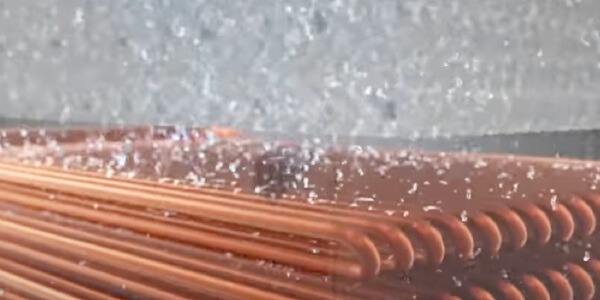
Secondary Loop (External Sprinkler System)
Water drawn from the cold-water basin is sprayed over the heat-exchange coils and fill, then returned for reuse. This loop manages only heat dissipation and does not enter the internal circuit, isolating impurities, algae, and scaling risks entirely.
Operating Principle
Dual-Circuit Independent Heat-Exchange Architecture
The system adopts a fully isolated dual-circulation structure, eliminating cross-contamination and preventing all water-quality degradation pathways at the source.
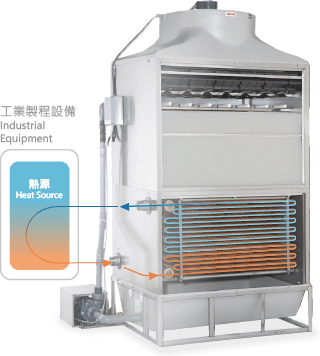
Primary Loop (Internal / Process Circuit)
-
Working Medium: purified water, soft water, tap water, or dedicated coolant.
-
Cycle Path: circulates within the fully closed coil heat exchanger and exchanges heat with customer equipment (e.g., injection molding machine heat exchangers, furnaces). Heat is removed through evaporative cooling when the external loop sprays water across the coil surface. Drift water returns to the basin for reuse.
-
Core Value: the internal loop remains permanently clean, concentration stays constant, zero evaporation loss, and scaling/corrosion/algae conditions are physically eliminated — preserving equipment life and thermal efficiency.
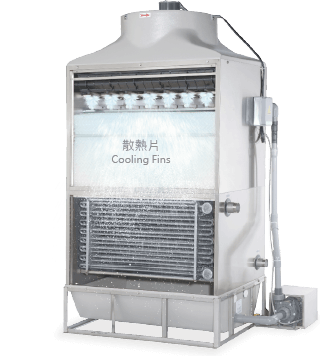
Secondary Loop (External / Heat Dissipation Circuit)
-
Working Medium: conventional cooling water exposed to ambient air.
-
Cycle Path: external water is evenly sprayed over the heat exchanger surface, removing heat via evaporation. Drift water collects in the basin and is reused.
-
Core Value: this loop absorbs all impurities and environmental stress as a sacrificial cycle, keeping the internal loop absolutely clean. Its water degradation does not affect cooling efficiency.
Technical Features
-
90% Reduction in Water Treatment Costs: complete separation of internal/external water eliminates the need for chemicals in the primary loop.
-
Core Equipment Protection: prevents scaling and corrosion in process heat exchangers, avoiding chemical cleaning damage and reducing downtime.
-
Sustained Thermal Performance: no scaling means temperature stability over years of operation.
-
Modular Components: pumps, piping, and coils are modular for easy maintenance and upgrades.
-
Productivity & Performance Boost: ideal for injection molding, semiconductor, and metal-processing industries requiring stable thermal conditions.
Through complete “dual-loop isolation” and “fully closed water-quality management,” Linkcooling delivers a cooling solution that is not only efficient but also low-maintenance, long-life, and environmentally sustainable.